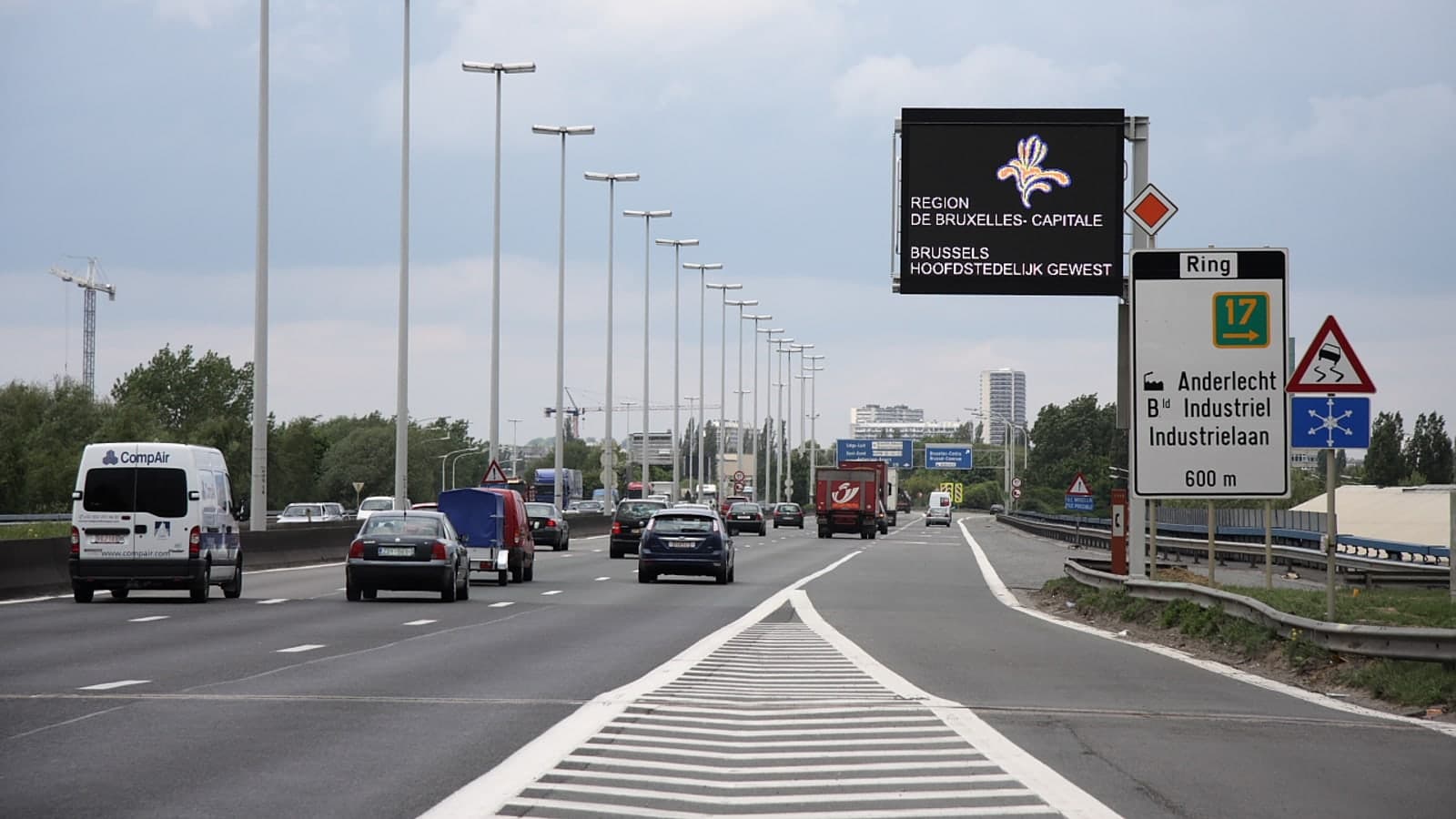
Must Brussels Ring signs be bilingual, and what should drivers expect?
Flemish mobility minister Annick De Ridder has rejected advice to make disputed Ring signs in Wemmel bilingual, BRUZZ reported on 7 September 2026. Drivers should continue preparing for Dutch destination names: the advice has not produced an agreed replacement programme.
Drivers need to recognise destinations despite language changes. Residents also need to understand which authority supplies public information and how to question its language choices.
Flemish mobility minister Annick De Ridder has rejected a language watchdog’s advice to add French to disputed Brussels Ring signs in Wemmel, BRUZZ reported on 7 September 2026. For drivers, the practical takeaway is to keep recognising Dutch destination names when planning journeys: the minister’s response offers no prospect of an immediate switch to bilingual signs. The disagreement concerns how language protections apply at this particular location, rather than a newly agreed policy for the entire orbital road. [BRUZZ’s reporting](https://www.bruzz.be/actua/mobiliteit/taalcommissie-oordeelt-dat-wegwijzers-langs-ring-tweetalig-moeten-zijn-de-ridder-weigert-2026-09-07).
The precise location helps explain the argument. In its published case file, the Vaste Commissie voor Taaltoezicht, or VCT, identifies signs at an R0 entrance in Wemmel. The municipality told the commission that the connecting Limburg Stirumlaan was under municipal management, with bilingual signs, while the Ring access infrastructure belonged to the Agentschap Wegen en Verkeer, or AWV. A short journey can therefore take a driver between signs supplied by different authorities. [VCT opinion 57.321](https://vct-cpcl.be/sites/default/files/documenten/advies-57321-y-fw-az.pdf).
The commission adopted its opinion on 3 July 2026, backing bilingual wording with Dutch given precedence. Its central reasoning was that residents should not lose their language facilities because the signs also serve outsiders. Seven members supported the opinion and three opposed it; the dissenters endorsed AWV’s position. That division matters: the watchdog reached a majority interpretation, not a unanimous settlement of the dispute. [The published opinion](https://vct-cpcl.be/sites/default/files/documenten/advies-57321-y-fw-az.pdf).
The Flemish government approaches the same signs from the other direction. According to Business AM’s account of the response from De Ridder’s spokesperson, Xavier Lesenne, Wemmel remains Flemish territory, and motorway directions address the general travelling public rather than specifically local residents. The minister therefore considers Dutch sufficient. This is the point of disagreement: whether the audience for a sign permits the regional authority to distinguish it from other public communications in a municipality with language facilities. [Business AM](https://businessam.be/vlaanderen-botst-met-taalcommissie-over-verkeersborden-op-de-ring/).
For newcomers, the essential distinction is between a multilingual country and a uniformly bilingual administration. The Flemish government’s official Taalwetwijzer explains that Belgium has four language areas. Brussels-Capital is the bilingual Dutch–French area; Wemmel belongs to the Dutch-language area but has a special language regime. Living near Brussels does not, by itself, place an address within Brussels-Capital or give every neighbouring municipality the same administrative obligations. [Vlaanderen.be’s language-area guide](https://www.vlaanderen.be/uw-overheid/over-vlaanderen/taalwetwijzer/taalgebieden-in-belgie).
The same official portal lists six municipalities around Brussels with these facilities: Wemmel, Drogenbos, Linkebeek, Sint-Genesius-Rode, Kraainem and Wezembeek-Oppem. Its administrative-language guide says their local services issue public notices in Dutch and French, with Dutch taking precedence. A gemeente—the Dutch term for municipality, or commune in French—therefore needs to be distinguished from the regional body responsible for a motorway. For a resident trying to understand a letter or a sign, identifying the responsible institution is a useful first step. [Official administrative-language guidance](https://www.vlaanderen.be/uw-overheid/over-vlaanderen/taalwetwijzer/taalwetgeving-in-bestuurszaken/bestuurstaal-van-de-overheid).
The present confrontation also has a long paper trail. A Flemish parliamentary bulletin published in April 2005 records an earlier dispute over Dutch-only Ring signs in Wemmel. It reproduces a 2001 instruction from then minister Steve Stevaert to replace ageing or damaged bilingual signs gradually. The subsequent ministerial answer said there were no plans to restore removed bilingual signs. Seen against that record, September’s disagreement is a renewed contest over an established policy, rather than a sudden discovery that Belgian places have different names in different languages. [Flemish Parliament archive, questions 135 and 137](https://docs.vlaamsparlement.be/docs/bva/2004-2005/va11-29042005.pdf).
Those names remain the immediate practical issue. Business AM identifies Bergen and Namen on the disputed signage: the Dutch names for Mons and Namur. Before an unfamiliar journey, check both versions of your destination and note the road number and intended exit alongside the name. If you are giving directions to visiting relatives or a newly arrived colleague, including both names can remove an avoidable moment of uncertainty. That is practical preparation, not a prediction that any particular sign will be replaced. [Reported destination examples](https://businessam.be/vlaanderen-botst-met-taalcommissie-over-verkeersborden-op-de-ring/).
Anyone wanting to raise a language complaint can consult the VCT’s official instructions. They allow submissions by email to [email protected] and ask for the complainant’s identification, an account of the facts and supporting evidence. For a signage issue, record the exact location and wording when safely able to do so. For help understanding which language rules apply to an authority, the regional Taalwetwijzer provides a separate explanatory starting point. [VCT complaint instructions](https://www.vct-cpcl.be/nl/klachten/hoe), [Taalwetwijzer](https://www.vlaanderen.be/uw-overheid/over-vlaanderen/taalwetwijzer).
What happens next depends on the administrative response and any further challenge. The VCT explains that its ordinary advice is non-binding, although authorities must report what action they take. That distinction prevents a recommendation from being mistaken for a court order or a scheduled installation programme. [VCT procedure](https://cpcl-vct.be/nl/klachten/procedure). BRUZZ reports that complainant organisation Gerfa is considering the Council of State if Flanders does not act. As of 8 September 2026, the sources reviewed establish that possibility, but do not confirm a filed case or a timetable for changing the signs. [BRUZZ](https://www.bruzz.be/actua/mobiliteit/taalcommissie-oordeelt-dat-wegwijzers-langs-ring-tweetalig-moeten-zijn-de-ridder-weigert-2026-09-07).
Impact
Regional — The immediate dispute concerns Flemish infrastructure at Wemmel. It does not establish a replacement programme across the Brussels Ring.
Local — The case illustrates why municipal and regional signs on a connected journey can receive different treatment.
International — Visitors unfamiliar with Dutch place names face a navigation issue, but this remains a Belgian administrative dispute.
What it means for you
Check both language versions of unfamiliar destinations before departure. For language complaints, use the VCT’s published email procedure and provide identification, facts and supporting evidence.
Opposing perspectives
- VCT majority
The majority considers bilingual signs necessary because residents also use them; serving a wider audience should not remove their language facilities.
- Flemish mobility minister Annick De Ridder
The minister maintains that directions for the general travelling public can remain Dutch-only because Wemmel belongs to the Dutch-language area.
- Gerfa, the complainant organisation
Gerfa argues that bilingual directions support lawful public service and clearer navigation. Its safety argument is an attributed position, not a demonstrated collision finding.
Sources & evidence
- View sourceVCT — opinion 57.321Primaryprimary· vct-cpcl.be· 3 July 2026Retrieved 8 September 2026· 91 days ago· Dated
- View sourceBRUZZ — language commission advice and Flemish refusalcorroborating· bruzz.be· 7 September 2026Retrieved 8 September 2026· 25 days ago· Dated
- View sourceBusiness AM — Flemish response and destination examplescorroborating· businessam.be· 7 September 2026Retrieved 8 September 2026· 25 days ago· Dated
- View sourceVlaanderen.be — language areas in Belgiumofficial· vlaanderen.beRetrieved 8 September 2026
Related to this story
Pulse Insight — This topic connects to 10 associations and 2 funding programmes through the Flanders ecosystem.
Live connections from the Belgium Impulse ecosystem — not recommendations.
This briefing was prepared with AI assistance and reviewed by a Belgium Impulse editor before publication. methodology.