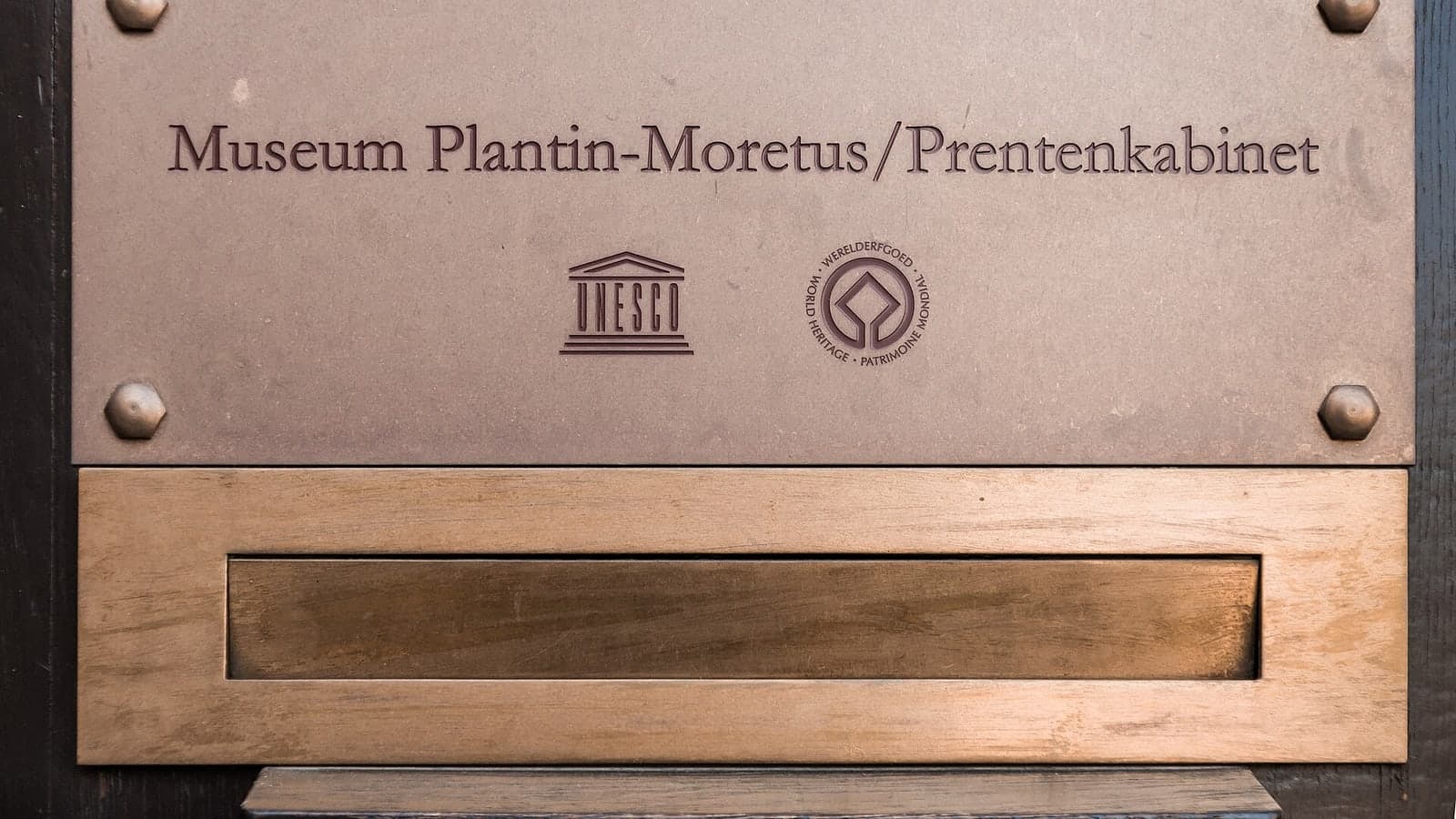
What will change while Antwerp’s Plantin-Moretus Museum closes for four months?
Antwerp’s Museum Plantin-Moretus closed on 3 August for four months of structural work and a redesigned permanent exhibition, with reopening celebrations planned for 5 and 6 December 2026.
The closure temporarily removes a major Antwerp attraction and the only surviving Renaissance and Baroque printing-and-publishing complex of its kind from public access. The renewal will test whether modern interpretation can broaden access while respecting the authenticity required of a UNESCO World Heritage property.
Antwerp’s Museum Plantin-Moretus closed on 3 August for four months of renovation, temporarily removing one of Belgium’s most internationally significant heritage sites from the city’s cultural circuit. The city-owned museum says it will reopen on 5 December, with a celebratory weekend on 5 and 6 December unveiling a redesigned permanent exhibition.
The closure affects the historic house and printing works on Vrijdagmarkt, rather than merely a detachable gallery space. Visitors, residents and tourists must therefore postpone trips to the complex until December. The museum’s public announcement gives no alternative Antwerp venue where its principal objects can be viewed during the works, although its website and digital material remain available.
VRT NWS reported the four-month closure as the museum began the renovation. The institution says the project combines necessary structural work with a new visitor route, contemporary scenography and an interactive app. The aim is to make the intertwined histories of the Plantin-Moretus family, its workers and its publishing business more accessible to a wider audience.
That balance matters because this is an unusually intact working and domestic environment, not simply a collection of early books. UNESCO describes the complex as the world’s only surviving printing workshop and publishing house from the Renaissance and Baroque periods. It preserves historic presses, type-founding and composing equipment, business records, a library and art associated with Peter Paul Rubens, all in the setting where the Plantin and Moretus families lived and worked.
The closure also prepares the museum for a double anniversary. According to the City of Antwerp, 2026 marks 450 years since Christophe Plantin established his printing and publishing operation at Vrijdagmarkt and 150 years since the premises became a museum. Nine generations of the Moretus family had continued the business before the complex passed into public ownership in the nineteenth century.
Antwerp culture councillor Lien Van de Kelder framed the renewal as growth anchored in “150 years of museum and 450 years of printing history”. That municipal emphasis is on a more inviting public experience: clearer storytelling, updated presentation and digital interpretation. It reflects the practical challenge facing historic-house museums, which must engage visitors without allowing screens or theatrical design to overwhelm the place itself.
UNESCO’s perspective puts the other side of that tension into sharper focus. Its World Heritage documentation stresses the complex’s authenticity, its furnishings and equipment preserved in their original setting, and the need for interventions to safeguard both the building and collections. Because the site is protected Flemish heritage, work affecting it is subject to regional heritage oversight. The museum itself says it follows a principle of “slow conservation”, favouring limited, evaluated interventions over excessive transformation.
No public disagreement between the City of Antwerp, the museum, UNESCO or the Flemish authorities has been reported. Their priorities are nevertheless distinct: city officials foreground accessibility and visitor experience, while the international heritage framework places authenticity and conservation first. The success of the renovation will depend on whether the new presentation serves both.
The broader significance extends well beyond Antwerp. Plantin’s publishing house operated within a European network of scholars, merchants, craftspeople and religious authorities at a time when printed material was transforming science and public life. UNESCO identifies Antwerp alongside Paris and Venice as one of early European printing’s leading centres. The surviving business archive shows that knowledge circulation was also an enterprise shaped by capital, labour, censorship and cross-border trade.
For Belgium-based visitors, the immediate consequence is straightforward: the Museum Plantin-Moretus remains unavailable through 4 December. The main questions now concern details the institution has not yet published, including the project’s cost, the precise scope of the structural work and the full reopening programme. On 5 and 6 December, attention will turn from the closure itself to whether the renewed rooms make this globally important history clearer without diminishing the rare authenticity that made the museum exceptional.
Impact
Regional — Visitors to Antwerp must adjust cultural itineraries until December, while the City of Antwerp and its museums lose access to an important attraction for four months. The refreshed presentation could strengthen the city’s heritage offering during the winter tourism season.
Local — The closure creates a temporary gap in Antwerp’s historic-centre museum offer. Visitors should not travel to Vrijdagmarkt expecting access before 5 December.
International — The site documents Antwerp’s position in the early European circulation of books and ideas. Its UNESCO status makes the quality of the renovation relevant to an international heritage community, although the project itself remains locally managed.
What it means for you
The building is closed through 4 December 2026. Visitors should plan for the reopening from 5 December and consult the museum website before travelling, as detailed event and ticket information may change.
Opposing perspectives
- City of Antwerp and public-access perspective
Antwerp culture councillor Lien Van de Kelder and the museum present the renovation as a way to let a historic institution grow: the revised route, scenography and app are intended to make its printing and family history more accessible and engaging for a broad contemporary audience.
- UNESCO and conservation perspective
UNESCO’s framework places the emphasis on authenticity, original equipment, historic interiors and careful management of the collections. That perspective does not oppose public access, but it requires new interpretive elements and structural interventions to remain subordinate to the integrity of the world heritage site.
Sources & evidence
- View sourceVRT NWSPrimaryprimary· vrtnws.beRetrieved 18 August 2026
- View sourceMuseum Plantin-Moretus closure noticeofficial· museumplantinmoretus.beRetrieved 18 August 2026
- View sourceMuseum Plantin-Moretus press officeofficial· pers.museumplantinmoretus.beRetrieved 18 August 2026
- View sourceCity of Antwerp museums preview for 2026official· pers.antwerpen.beRetrieved 18 August 2026
Related topics
Related to this story
Pulse Insight — This topic connects to 10 associations and 2 funding programmes through the Flanders ecosystem.
Live connections from the Belgium Impulse ecosystem — not recommendations.
This briefing was prepared with AI assistance and reviewed by a Belgium Impulse editor before publication. methodology.