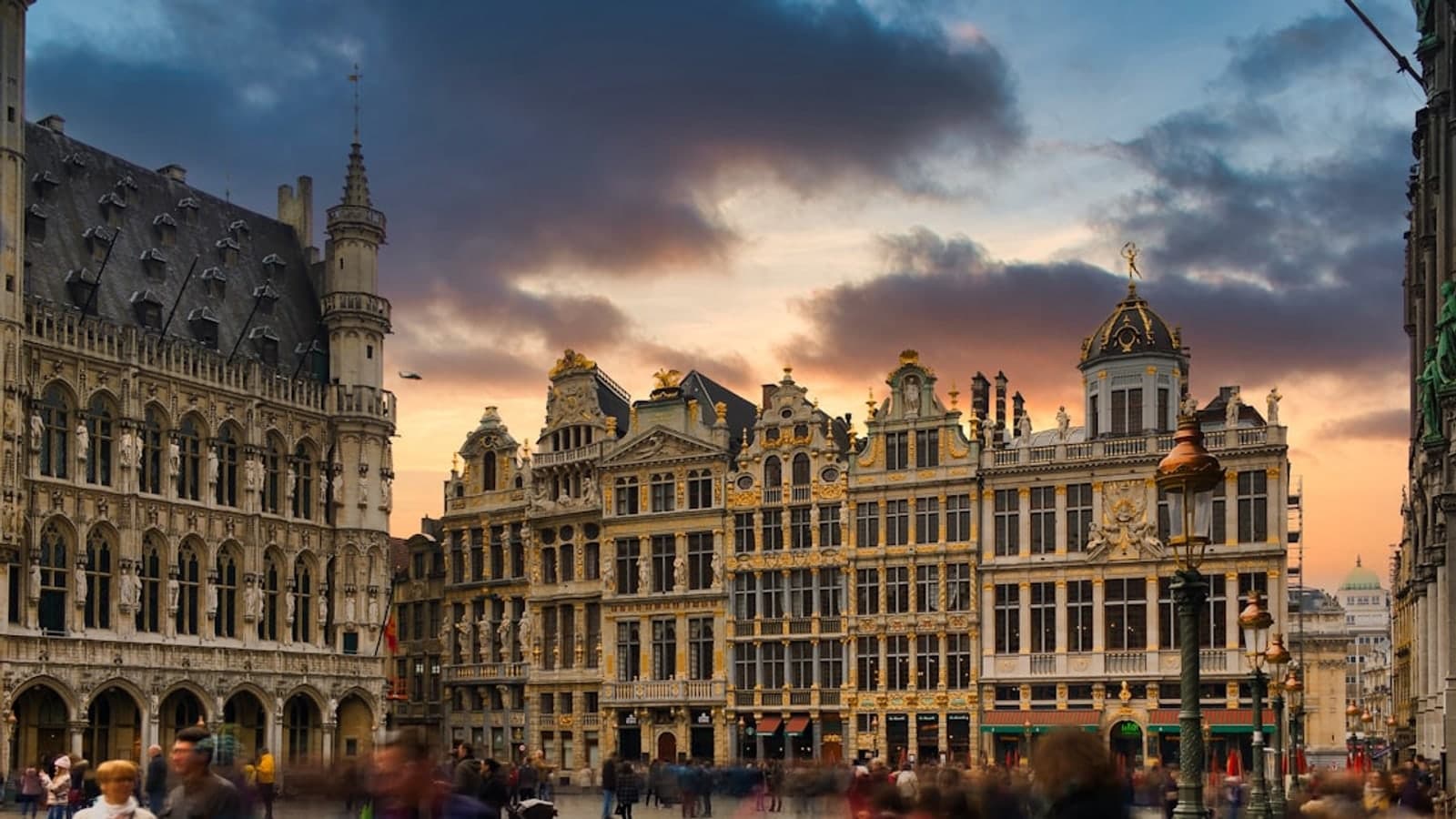
Why did Brussels queue for hours for the last eclipse glasses?
Brussels residents queued for up to two hours on 12 August as several retailers ran out of certified glasses before Belgium experienced a deep partial solar eclipse.
The episode combined a rare Europe-wide astronomical event with an immediate public-health issue: looking directly at a partially eclipsed Sun can permanently damage the retina, while certified viewers had become difficult to obtain.
residents queued for up to two hours on Wednesday, 12 August, after several retailers ran out of certified glasses needed to watch ’s deep partial solar eclipse safely. reported that late deliveries drew crowds only hours before the event, turning an international astronomical spectacle into a distinctly local scramble for protective equipment.
The rush mattered because was outside the narrow path of totality crossing , , and a small part of north-eastern . Viewers in therefore needed to keep proper eye protection on throughout the eclipse: unlike observers experiencing totality, they had no safe interval in which to look directly at the Sun. The warned that viewing even a partially eclipsed Sun without suitable protection could cause permanent eye damage and that ordinary sunglasses were inadequate.
The shortages were not confined to the capital. Thierry Segaert, spokesperson for the Belgian Professional Association of Opticians and Optometrists, told that opticians across were rapidly exhausting their stocks. According to the figures he supplied, the public observatory in Hove had sold 130,000 pairs during 2026 and still held 50,000, but had stopped accepting online orders because they could no longer be processed in time. MIRA Observatory in Grimbergen had meanwhile seen its supply fall from 13,000 pairs to about 5,000 within days.
That national picture helps explain why the arrival of a small quantity in one shop could generate a long file. ’s report documented residents still trying to obtain the last eclipse glasses on the afternoon of the event, including one person who said the wait had lasted two hours. The broadcaster did not identify the shop or establish how many pairs were sold, so the scene should be read as evidence of intense last-minute demand rather than a complete measure of shortages across Brussels.
Opticians represented by Segaert framed the episode primarily as a consumer-safety and supply problem. Their advice was to use new products carrying the CE marking and a reference to the EN ISO 12312-2 standard, and not to improvise with ordinary sunglasses, photographic filters or 3D glasses. The offered a broader European framing: science director Carole Mundell described the eclipse as a rare shared experience capable of connecting millions of people with solar research. From , both perspectives were visible at once — an uplifting continental event, but one mediated locally by scarce equipment and the practical need to protect eyesight.
Belgian institutions expanded the alternatives. The organised public viewing from its radio-astronomy station at , near Marche-en-Famenne, while observatories and astronomy groups prepared supervised sessions in locations including Grimbergen, Genk, Mons, Manhay, Ypres, Bruges and Antwerp. In itself, the Basilica of Koekelberg released 125 places on its panorama, while the Royal Museum of the Armed Forces offered room for 40 people above the Cinquantenaire arch; the limited capacities underscored the scale of public interest.
The wider scientific story extended well beyond spectators. ’s Proba-3 mission created an artificial eclipse in orbit hours before the natural event, while KU Leuven researchers contributed computer modelling of the solar corona. That Belgian-European link is substantive but secondary: the main event remained a total eclipse across parts of the North Atlantic and Iberian Peninsula, seen only partially from .
The immediate rush has passed, but the practical lesson remains. Future eclipse planning will need earlier public information, wider distribution of certified viewers and clear promotion of supervised observation or indirect projection. It remains unknown how many people in failed to obtain glasses or whether local health services recorded eclipse-related eye injuries.
Impact
Regional — Brussels experienced acute last-minute demand, while limited-capacity viewing sites at Koekelberg and the Cinquantenaire offered elevated western views. Similar shortages and organised observations were reported elsewhere in Belgium.
Local — In Brussels, shortages turned the final search for certified eclipse glasses into queues lasting as long as two hours. Residents who already had suitable protection could use limited-capacity observation sites at Koekelberg and the Cinquantenaire, both offering elevated views toward the west. The pressure was therefore felt both at retailers and at organised viewing locations. Elsewhere in Belgium, the Royal Observatory of Belgium provided supervised observation at Humain, while other locations also reported shortages and organised gatherings.
International — The eclipse linked Brussels and Belgium to a wider astronomical event spanning the North Atlantic and south-western Europe. Totality crossed Greenland, Iceland, Spain and a small part of Portugal, whereas Belgium experienced a deep partial eclipse. The European Space Agency supplied public eye-safety guidance and subsequently reviewed the event, giving audiences across borders a common scientific reference point. The different conditions along and outside the path of totality also mattered practically: Belgian viewers required protection throughout, unlike observers experiencing the total phase on the totality path.
What it means for you
The 12 August 2026 event has passed, so there is no remaining purchase or travel decision for this eclipse. For future partial eclipses visible from Belgium, obtain certified eclipse glasses well before the event rather than relying on last-day Brussels stock. Do not substitute ordinary sunglasses: they do not prevent permanent solar retinal injury. Check whether an organised, supervised observation requires advance admission or has limited capacity, as the Koekelberg and Cinquantenaire sites did. If ordering online, allow enough delivery time; Urania stopped taking orders once arrival before the eclipse was no longer possible.
Opposing perspectives
- Belgian opticians’ safety-and-supply framing
Thierry Segaert and the Belgian Professional Association of Opticians and Optometrists treated the rush chiefly as a product-safety problem: certified new glasses were running short, while improvised filters and ordinary sunglasses could expose buyers to irreversible retinal damage.
- ESA’s European science framing
ESA science director Carole Mundell presented the eclipse as a shared European experience that could inspire curiosity and connect the public with solar research. This framing emphasised collective discovery rather than the retail scarcity dominating the Brussels street-level story.
Who, where and what
Key people, places and terms in this story
City where residents queued for the remaining certified eclipse glasses and where viewing sites opened.
Country that experienced a deep partial solar eclipse on 12 August 2026.
One of the countries crossed by the path of totality.
One of the countries crossed by the path of totality.
Country whose north-eastern area included a small part of the totality path.
Show the full library (15)
City where residents queued for the remaining certified eclipse glasses and where viewing sites opened.
Country that experienced a deep partial solar eclipse on 12 August 2026.
One of the countries crossed by the path of totality.
One of the countries crossed by the path of totality.
Country whose north-eastern area included a small part of the totality path.
One of the territories crossed by the path of totality.
Location of the Royal Observatory of Belgium's supervised viewing event.
Astronomical event that produced totality in parts of Europe and a deep partial eclipse over Belgium.
Brussels media outlet that reported queues lasting as long as two hours for eclipse glasses.
Publication that carried Belga reporting on the increasing difficulty of obtaining protective glasses.
News agency credited on reporting about shortages of protective eclipse glasses.
European space organisation that issued eye-safety advice and reviewed the eclipse.
Abbreviated name used for the European Space Agency in its warning about permanent solar eye damage.
Astronomy organisation that reported selling 130,000 pairs of eclipse glasses in 2026 and closed late online orders.
Belgian scientific institution that organised supervised eclipse viewing at Humain.
Sources & evidence
- View sourceBX1Primaryprimary· bx1.be· 12 August 2026Retrieved 29 August 2026· 51 days ago· Dated
- View sourceSoirmag / Belgacorroborating· soirmag.lesoir.be· 5 August 2026Retrieved 29 August 2026· 58 days ago· Dated
- View sourceEuropean Space Agencyofficial· esa.int· 21 May 2026Retrieved 29 August 2026· 134 days ago· Dated
- View sourceEuropean Space Agencyofficial· esa.int· 14 August 2026Retrieved 29 August 2026· 49 days ago· Dated
Related topics
Related to this story
Pulse Insight — This topic connects to 10 associations and 1 funding programme through the Brussels ecosystem.
Live connections from the Belgium Impulse ecosystem — not recommendations.
This briefing was prepared with AI assistance and reviewed by a Belgium Impulse editor before publication. methodology.