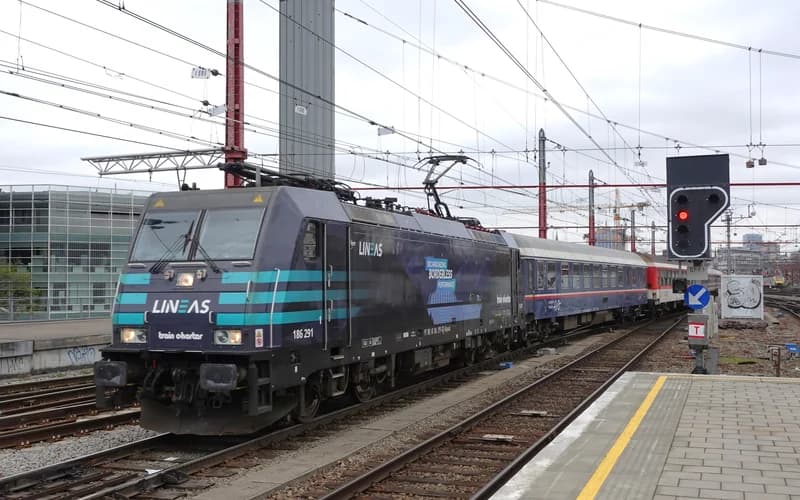
Will Brussels really get a direct night train to Copenhagen and Malmö in 2028?
European Sleeper and German operator RDC are preparing a direct night train from Brussels and Antwerp to Copenhagen and Malmö for April 2028, but track capacity, rolling stock, prices and final regulatory arrangements remain unresolved.
The service would give residents of Belgium a direct overnight rail option to Denmark and Sweden, widening the practical alternative to short-haul flying. More broadly, its success or failure will test whether Europe’s pro-rail policy can overcome scarce track capacity, fragmented operating requirements and limited sleeper rolling stock.
and German rail company RDC announced on 25 August that they are preparing a direct night train from to and Malmö for April 2028, giving a planned overnight link to and southern . The operators envisage three departures a week in each direction, with among the Belgian stops, but the train is not yet an approved or bookable service.
For people based in , the attraction is unusually concrete: boarding at at about 19:00 and reaching or Malmö around 10:00 the following morning, without changing trains. says the proposed route would continue through and before crossing to . It would place Copenhagen within one overnight journey and offer onward connections from Malmö towards Stockholm and from Copenhagen towards the rest of Denmark.
The regulatory paper trail supports the seriousness of the proposal, while also showing how much work remains. Authority for Consumers and Markets, ACM, says formally notified it on 21 August of an open-access service between and Malmö, starting on 1 April 2028. The filing specifies outward departures on Tuesdays, Thursdays and Sundays and return trains on Mondays, Wednesdays and Fridays. It also says passengers would not be allowed to use the service for domestic journeys within the Netherlands.
A notification is not the same as a guaranteed timetable. says it and RDC are now working with infrastructure managers along the route before a formal capacity application in April 2027. Track access must be coordinated across , , , and , including heavily used corridors where passenger trains, freight services and overnight engineering works compete for space. Fares, carriage types, exact intermediate stops and ticket-sale dates have not been announced.
co-founder Chris Engelsman presents Scandinavia as the logical next stage for the Belgian-Dutch operator. In RDC’s announcement, he said the partnership could bring another part of Europe within a comfortable overnight journey. RDC chief executive Markus Hunkel emphasised his company’s experience operating night trains between and Scandinavia and its ability to supply operational expertise and rolling stock.
That commercial confidence needs to be read alongside the industry’s less romantic realities. VRT NWS has previously reported that European night-train expansion has proceeded more slowly than hoped because of differing national rules, high operating costs and a chronic shortage of suitable carriages. itself is relying on RDC for rolling stock on other services, making the partnership central rather than incidental to the Scandinavian plan.
already serves as ’s western anchor. The company began running between Brussels and Berlin in 2023 and subsequently extended that service to Prague. Its published 2026 timetable also lists routes linking Brussels with Paris, Berlin and Prague, while the company says a Brussels-Milan service is due to begin in September 2026. These operations give the Scandinavian proposal more substance than a route drawn from scratch, although past European Sleeper ambitions have also encountered delays.
The broader policy climate is favourable. The European Commission’s cross-border rail action plan identifies fragmented regulation, scarce rolling stock and infrastructure constraints as barriers to long-distance services. Its 2025 high-speed rail strategy argues that better capacity coordination, easier cross-border operation and investment in infrastructure should also benefit night trains. Transport Commissioner Apostolos Tzitzikostas framed stronger rail links as part of a more competitive and carbon-neutral Europe, a public-policy case broader than the operators’ focus on destinations and passenger convenience.
No specific endorsement from ’s federal transport authorities, or infrastructure manager accompanied the announcement reviewed for this article. Their eventual role will matter at and , but here is first a departure city, not shorthand for the EU institutions. The EU connection lies in the rules and infrastructure governing a five-country railway.
The decisive milestone is April 2027, when the operators intend to seek formal capacity. Until viable train paths and carriages are secured, travellers should treat April 2028 as a target rather than a settled opening date. The next meaningful evidence will be an allocated timetable, confirmed Belgian stops, published fares and tickets actually going on sale.
Impact
Regional — Bruxelles-Midi would be the southern terminus and Antwerp a Belgian intermediate stop, strengthening both cities’ international rail links. No detailed operational response from SNCB/NMBS, Infrabel or the federal transport authorities was identified in the reviewed announcements.
Local — Bruxelles-Midi would be the route’s southern terminus, while Antwerp would receive a direct overnight connection to Copenhagen and Malmö. That would let passengers in Belgium board for Scandinavia without first travelling to a foreign departure station or changing trains overnight. The proposal does not yet establish platforms, final timings, fares or local connecting arrangements. No detailed operational position from SNCB/NMBS, Infrabel or Belgian federal transport authorities was identified in the announcements reviewed for the article.
International — The proposed train would cross Belgium, the Netherlands, Germany and Denmark before reaching Sweden, making it a practical test of EU ambitions for more cross-border passenger rail. European Sleeper and RDC Deutschland must secure compatible infrastructure capacity and satisfy operating requirements across multiple national systems. The project therefore illustrates the gap between European Commission support for international rail and the route-level work needed to allocate train paths, provide sleeper rolling stock and complete regulatory arrangements.
What it means for you
Do not make firm travel plans for 2028 yet: tickets, fares, final stops and confirmed timetables have not been announced. The first date to watch is April 2027, when the operators expect to submit their formal infrastructure-capacity application. If the project proceeds, the target first departure is 1 April 2028, with three services weekly in each direction. Brussels and Antwerp passengers could leave at roughly 19:00 and reach Copenhagen or Malmö around 10:00 the next morning. Travellers should compare prices and booking conditions only after sales formally open.
Opposing perspectives
- European Sleeper and RDC: a commercially attractive northern expansion
Chris Engelsman describes Scandinavia as a logical next step for European Sleeper, while RDC chief Markus Hunkel stresses the German company’s night-train experience and sees substantial potential in combining that expertise with European Sleeper’s network and customer base.
- Rail regulators: a filed intention is not a secured train service
The Dutch ACM frames the project more narrowly as a notified open-access passenger service. Its notice establishes the proposed dates and frequency but does not amount to a final timetable allocation or a guarantee that all required cross-border capacity will be available.
- European Commission: new routes depend on structural reform
The Commission supports stronger international rail but places the emphasis on infrastructure, interoperable rules, rolling-stock finance, ticketing and coordinated capacity. That institutional framing tempers the operator’s destination-led message: enthusiasm alone cannot make a five-country railway work.
Who, where and what
Key people, places and terms in this story
Belgian origin city for the planned Scandinavian night train.
Planned Belgian intermediate stop on the route.
Origin country through which the proposed international service would operate.
Transit country on the proposed cross-border route.
Destination country containing Malmö.
Show the full library (15)
Belgian origin city for the planned Scandinavian night train.
Planned Belgian intermediate stop on the route.
Origin country through which the proposed international service would operate.
Transit country on the proposed cross-border route.
Destination country containing Malmö.
Planned southern terminus and boarding point in Brussels.
Planned Danish destination and stop before Malmö.
Planned Swedish terminus of the overnight service.
Country on the proposed route and jurisdiction where the service notification was filed.
Transit and destination country containing Copenhagen.
Belgian-Dutch open-access night-train operator proposing the Brussels–Malmö service.
German rail operator planning to operate the proposed service with European Sleeper.
Dutch regulator that published the notification for the proposed passenger service.
Belgian national passenger operator from which no detailed operational response was identified.
Belgian rail infrastructure manager from which no detailed operational response was identified.
Sources & evidence
- View sourceBRUZZPrimaryprimary· bruzz.be· 25 August 2026Retrieved 27 August 2026· 38 days ago· Dated
- View sourceDe Morgencorroborating· demorgen.be· 25 August 2026Retrieved 27 August 2026· 38 days ago· Dated
- View sourceEuropean Sleeperprimary· europeansleeper.euRetrieved 27 August 2026
- View sourceRDC Deutschlandprimary· rdc-deutschland.de· 25 August 2026Retrieved 27 August 2026· 38 days ago· Dated
Related topics
Related to this story

Pulse Insight — This topic connects to 10 associations and 1 funding programme through the Brussels ecosystem.
Live connections from the Belgium Impulse ecosystem — not recommendations.
This briefing was prepared with AI assistance and reviewed by a Belgium Impulse editor before publication. methodology.