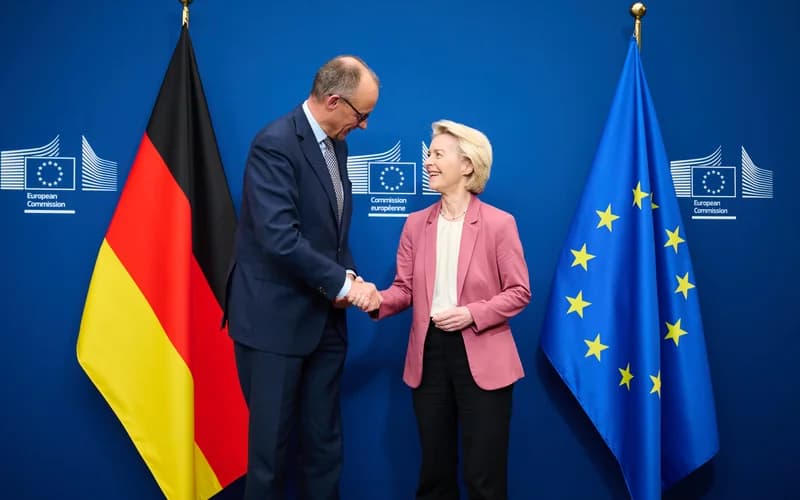
German Chancellor Merz booed during visit to fire-hit Eifel
German Chancellor Friedrich Merz faced boos, whistles and insults on Saturday during a visit to Hürtgenwald, near Belgium, where he thanked crews after North Rhine-Westphalia’s largest recorded forest fire.
The reception exposed public anger over political visibility during disasters and placed Germany’s wildfire preparedness under scrutiny as extreme heat and dry conditions raise the risk of larger fires.
Updated: 24 August 2026, morning CEST
German Chancellor faced boos, whistles and hostile shouts on Saturday afternoon, 22 August, during a visit to Gey in , a fire-hit municipality in near . and regional broadcaster reported that Merz completed the visit, thanked emergency crews and addressed the criticism surrounding his absence during the blaze.
Protesters displayed signs accusing the chancellor of arriving too late, while farmers sounded tractor horns during his statement, according to . Belgian newspaper reported that one person shouted a vulgar insult at Merz. Other news organisations confirmed the wider jeering but did not independently reproduce that specific wording. Merz told reporters that he would not be influenced by people shouting and said he had remained informed throughout the emergency.
The chancellor said he and Düren district administrator Ralf Nolten had agreed that a visit during the critical phase would have disrupted operations. Nolten publicly supported that account, reported. Timo Pleiß of ’s volunteer fire service likewise told the broadcaster that political visits were unhelpful during an active deployment but described the later appearance as recognition for responders.
The fire was extinguished on Thursday, two days before Merz arrived, according to . ZDF reported that the cause remained undetermined and that human error was being considered. Merz called the fire a consequence of climate change, warned that such emergencies would occur more often and promised a review of communications and preparedness with the federal cabinet.
The visit also carried political weight because it was Merz’s first public engagement since late July. Opposition politicians, particularly the Greens, had accused him of failing to show leadership during the heat and fires. Merz’s supporters and local emergency officials countered that keeping high-level delegations away during the operation allowed crews to concentrate on the fire.
enters the story through the neighbouring emergency, not through the protest itself. ’s government said on Monday morning that the Belgian fire was under control but that local flare-ups continued overnight. Roads and nature areas remained closed, while 140 to 160 responders had worked across the site on Sunday. Authorities are monitoring smoke and have told the public to respect exclusion zones.
German officials will now assess the response and remaining equipment or communications gaps. In , the immediate questions are when the perimeter can reopen, whether underground fires return and what environmental damage will emerge once inspectors can enter safely.
Impact
Regional — The German fire was extinguished, but Walloon authorities were still tackling local flare-ups in the nearby High Fens on 24 August. Closures continued on the N68, N672 and N676 and across affected nature areas.
Local — In eastern Wallonia, the immediate impact was continued disruption around the High Fens. On 24 August, authorities said the fire was under control but local flare-ups were still being tackled. The N68, N672 and N676 remained closed, along with affected nature areas, because of fire, smoke and hazards on the ground. Residents, motorists and visitors therefore needed to avoid closed routes and respect restrictions until Walloon authorities confirmed that access was safe.
International — The story has a direct Belgian-German dimension because Hürtgenwald lies near eastern Belgium within the wider cross-border High Fens-Eifel landscape. Separate fires and restrictions affected both North Rhine-Westphalia and Wallonia during the same period. Although no EU institution or formal cross-border mechanism is identified in the article, the proximity means smoke, access restrictions, visitor movements and fire-risk awareness matter on both sides of the border. The episode also puts neighbouring authorities’ wildfire preparedness and public communication in a shared regional context.
What it means for you
If you live in or plan to visit eastern Wallonia, check official Walloon updates before travelling through the High Fens. As of 24 August, the N68, N672 and N676 and affected nature areas remained closed because of fire, smoke and site hazards, despite the fire being under control. Do not enter closed nature zones or assume that extinguished flames mean immediate safe access: local flare-ups were continuing. Travellers heading toward the Belgian-German Eifel should allow extra time, choose alternative routes and monitor restrictions on both sides of the border.
Opposing perspectives
- Residents and Green opposition politicians
Residents who protested and Green parliamentary leader Katharina Dröge argued that Merz remained publicly absent for too long while emergency crews confronted exceptional fires and Germany endured severe heat.
- District and emergency-service officials
Düren district administrator Ralf Nolten and a Hürtgenwald volunteer-fire-service representative said a chancellor’s visit during the critical operational phase would have consumed resources or obstructed crews, while a later visit provided recognition.
Who, where and what
Key people, places and terms in this story
Neighbouring country affected by a separate fire and closures in the High Fens.
Belgian region managing the High Fens fire, flare-ups and access restrictions.
Country where the Hürtgenwald forest fire and Merz’s visit occurred.
Nature area in eastern Wallonia where a separate fire and local flare-ups prompted closures.
German federal chancellor who visited Hürtgenwald and faced boos, whistles and insults.
Show the full library (15)
German federal chancellor who visited Hürtgenwald and faced boos, whistles and insults.
Country where the Hürtgenwald forest fire and Merz’s visit occurred.
Neighbouring country affected by a separate fire and closures in the High Fens.
Belgian region managing the High Fens fire, flare-ups and access restrictions.
Nature area in eastern Wallonia where a separate fire and local flare-ups prompted closures.
Eifel municipality visited by Merz after the forest fire was extinguished.
Cross-border region containing Hürtgenwald and adjoining eastern Belgium.
German state where the largest recorded forest fire in its history occurred.
Cross-border Belgian-German landscape linking the two fire-affected areas.
German political party led by Friedrich Merz.
German broadcaster that confirmed the hostile reception during Merz’s visit.
German news programme that confirmed boos, whistles, protest signs and tractor horns.
German news outlet listed among the article’s sources on Merz’s visit.
Belgian news outlet listed among the article’s sources.
Regional authority providing official information on the High Fens fire.
Sources & evidence
- View sourceHLNPrimaryprimary· hln.be· 23 August 2026Retrieved 24 August 2026· 40 days ago· Dated
- View sourceTagesschaucorroborating· tagesschau.de· 22 August 2026Retrieved 24 August 2026· 41 days ago· Dated
- View sourceWDRcorroborating· www1.wdr.de· 22 August 2026Retrieved 24 August 2026· 41 days ago· Dated
- View sourceZDFheutecorroborating· zdfheute.de· 22 August 2026Retrieved 24 August 2026· 41 days ago· Dated
Related topics
Related to this story
Live connections from the Belgium Impulse ecosystem — not recommendations.
This briefing was prepared with AI assistance and reviewed by a Belgium Impulse editor before publication. methodology.